
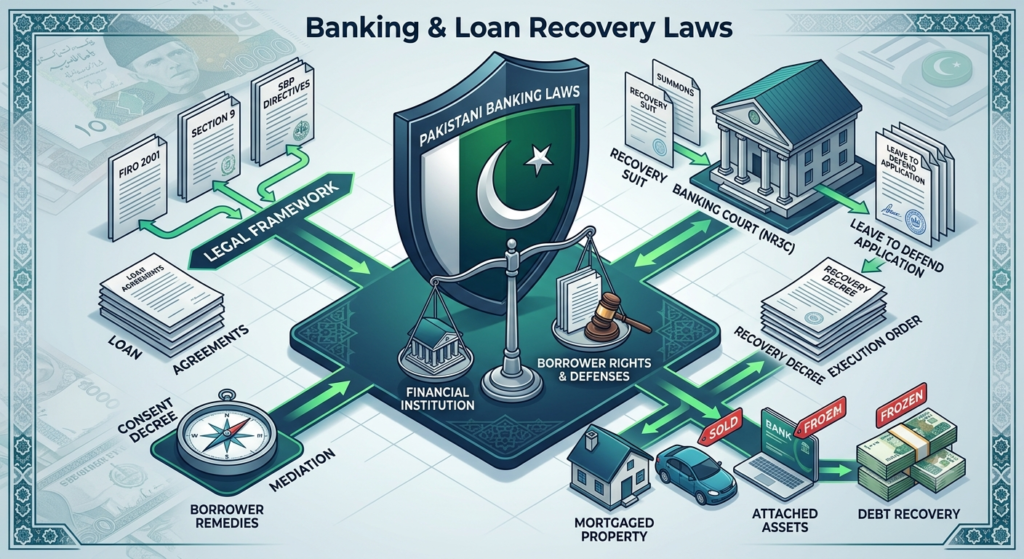
Financial transactions form the backbone of modern commerce, but loan defaults often create complex legal challenges. When individuals or businesses fail to repay bank loans in Pakistan, specific recovery laws govern how financial institutions collect their outstanding debts. Understanding these regulations helps both borrowers and financial institutions protect their legal interests.
Pakistani banking laws establish structured procedures for debt recovery while balancing the rights of borrowers against unlawful financial practices. This detailed legal guide explains the primary recovery statutes, court procedures, defense mechanisms, and practical steps for managing loan default disputes in Pakistan.
1. Primary Laws Governing Loan Recovery in Pakistan
Specialized statutes regulate banking disputes in Pakistan to ensure rapid resolution and prevent financial instability in the banking sector. Standard civil courts do not handle routine banking suits. Instead, dedicated banking tribunals hear these matters under specific federal laws.
The Financial Institutions (Recovery of Finances) Ordinance, 2001 (Firo)
This law serves as the primary legislation for recovering defaulted loans across Pakistan. It grants special powers to designated Banking Courts, enabling financial institutions to initiate quick recovery suits against defaulting customers.
The statute defines key terms like “finance,” “customer,” and “default” with precision to avoid ambiguity in court. Furthermore, it sets out distinct procedural rules that streamline litigation, reducing the prolonged delays commonly seen in ordinary civil courts.
The Banking Companies Ordinance, 1962
While FIRO handles direct debt recovery lawsuits, the Banking Companies Ordinance outlines overall regulatory framework for banking operations in the country. It empowers the State Bank of Pakistan (SBP) to issue binding directives regarding credit facilities, bad debt write-offs, and non-performing loans (NPLs).
This ordinance ensures that banks maintain transparent accounting standards when calculating interest, markup, and cost of funds for defaulting accounts. Consequently, financial institutions must strictly align their recovery claims with SBP directives.
2. Key Legal Procedures in Banking Courts
When a borrower defaults on loan payments, the lender follows a prescribed judicial procedure to secure a decree against the customer.
Notice of Default and Legal Demand
A bank cannot directly file a court case without issuing prior warnings. The recovery process begins when the bank issues a formal notice of default to the borrower.
This notice outlines the exact outstanding principal amount, accrued markup, and contractual penalties. The bank usually provides a specific timeframe, typically 7 to 14 days, allowing the customer to clear the dues before formal legal action starts.
Filing the Recovery Suit
If the borrower fails to respond or settle the debt, the bank files a recovery suit under Section 9 of FIRO 2001 before the relevant Banking Court. The plaint includes the original loan agreement, mortgage documents, account statements, and details of non-payment.
Once the court registers the suit, it issues summons to the defendant. The law requires prompt service of these summons through personal delivery, registered mail, and official newspaper publications.
Leave to Defend Application
Unlike standard civil lawsuits, a defendant in a banking suit does not possess an automatic right to file a written statement. Under Section 10 of FIRO 2001, the borrower must first file an Application for Leave to Defend within 30 days of receiving summons.
The borrower must raise substantial questions of law or fact in this application to secure permission from the judge to contest the suit. If the court finds the borrower’s defense weak or frivolous, it rejects the application and issues a recovery decree favoring the bank immediately.
3. Recovery Mechanisms and Enforcement of Decrees
Once a Banking Court issues a decree against a borrower, the bank uses several legal avenues to enforce the judgment and recover its money.
Sale of Mortgaged Properties
Banks routinely demand collateral, such as residential or commercial real estate, before approving major loans. Under Section 15 of FIRO 2001, banks hold special powers to sell mortgaged property without court intervention under strict procedural conditions.
However, if the bank opts for judicial enforcement, the Banking Court issues an execution order to auction the pledged assets. The court supervisor conducts a public auction, and the sale proceeds pay off the judgment debt directly.
Attachment of Bank Accounts and Other Assets
Besides pledged collateral, the court can attach un-pledged personal assets, bank balances, and business receivables of the decree-debtor. The judge issues attachment orders under the Code of Civil Procedure (CPC) to freeze the borrower’s financial resources until full debt settlement.
Arrest and Detention in Civil Prison
In extreme cases where a debtor willfully conceals assets or avoids execution despite holding sufficient financial capacity, the court can issue warrants for civil detention. The judge can commit the defaulter to civil prison for a period specified under the law, though this measure does not wipe away the underlying debt.
4. Legal Defenses Available to Borrowers
Borrowers facing recovery suits hold clear legal remedies to defend their rights against inflated demands or unfair banking practices.
- Unlawful Markup Calculation: Banks sometimes apply unlawful penalties, compounding interest improperly, or exceeding approved markup caps. Borrowers can challenge these excessive figures by requesting a independent court audit of account statements.
- Lack of Proper Notice: If a bank fails to serve mandatory statutory notices before filing a lawsuit or auctioning property, the court can invalidate the entire proceeding on procedural grounds.
- Forced Guarantees and Coercion: Individuals who signed loan documents or personal guarantees under duress, misrepresentation, or fraud can raise these claims during the leave to defend stage.
- Restructuring and Rescheduling Protocols: Borrowers experiencing temporary financial distress can request court intervention or SBP-mandated restructuring schemes to reschedule loan repayments over longer periods.
5. Practical Checklist for Managing Banking Suits
- Maintain Written Records: Save every loan agreement, payment receipt, bank statement, and email exchange between you and the financial institution.
- Act Quickly Upon Receiving Summons: Consult a specialized banking advocate immediately, because missing the strict 30-day window for filing a Leave to Defend application leads to an automatic decree against you.
- Verify Account Statements: Inspect the bank’s certified account statement line by line to identify incorrect service fees, hidden penalties, or miscalculated markup rates.
- Explore Out-of-Court Settlements: Consider negotiating a consent decree or mutually agreed settlement plan with the bank’s recovery team to reduce legal costs and save property from auction.