
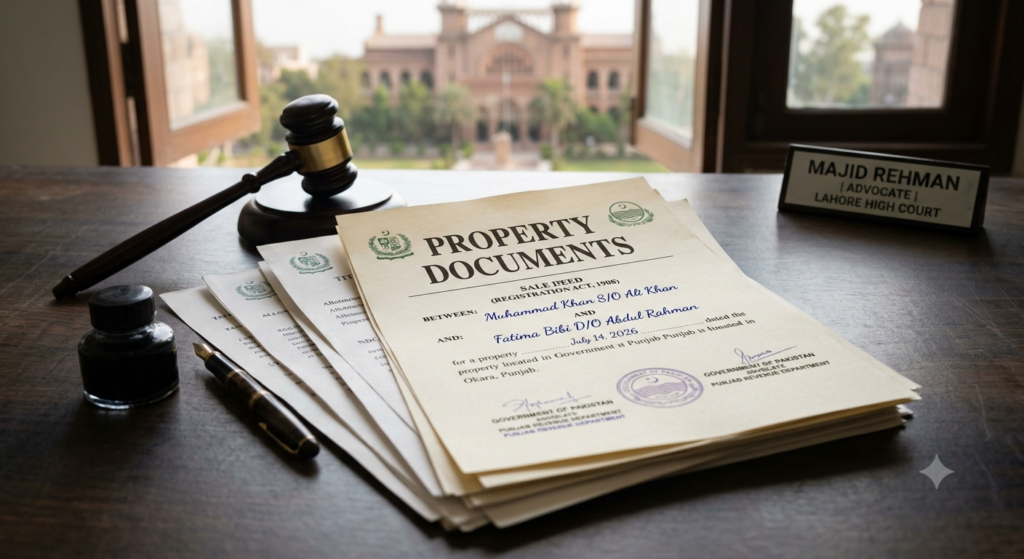
Transferring property ownership in Pakistan—whether through a commercial sale, an inheritance, or a family gift—is a formal legal process that demands careful documentation. Failing to compile verified land papers can lead to ownership disputes, financial loss, or prolonged litigation in civil courts.
Whether your land falls under the traditional Revenue Department (Patwarkhana / Arazi Record Center) or modern housing authorities like DHA, Bahria Town, or CDA, having the right paperwork in order is critical. This comprehensive guide details every essential document required to ensure a smooth, legal property transfer in Pakistan.
Primary Identification & Basic Verification Documents
Before drafting any transfer deeds, both parties must present valid personal identification and initial verification paperwork:
- CNIC / NICOP: Clear, attested copies of valid Computerized National Identity Cards (CNIC) for both the seller/donor and buyer/recipient. Overseas Pakistanis must provide their National Identity Card for Overseas Pakistanis (NICOP).
- Recent Passport-Sized Photographs: Recent color photographs of both parties for inclusion in official government record registers.
- Non-Demand Certificate (NDC) / No Objection Certificate (NOC): Issued by the relevant municipal body, development authority, or housing society (such as LDA, CDA, or RDA). This certificate verifies that all outstanding utility bills, property taxes, and development charges are fully cleared.
2. Essential Documents for Property Transfer via Sale (Bainama)
Buying or selling real estate requires establishing an unbroken chain of ownership and officially registering the transaction.
A. Proof of Seller’s Ownership
- Original Title Deed (Registry / Bainama): The existing, legally registered sale deed that proves the current seller is the legitimate owner.
- Fard-e-Malkiat (Record of Rights): A document issued by the local Sub-Registrar office or Arazi Record Center (PLRA) certifying current legal title, boundaries, and land details (Khewat, Khasra, and Khatooni numbers).
- Allotment & Transfer Letters: For properties located in private or semi-private housing schemes (e.g., DHA, Bahria Town, Askari), the original Allotment Letter serves as primary proof of ownership instead of a traditional Fard.
B. Transaction & Registration Documents
- Token & Bayana Receipt: Written proof of the initial advance payment (Bayana) made to secure the agreement.
- Sale Agreement (Iqrar-e-Nama): A binding contract drafted on non-judicial stamp paper detailing the total agreed purchase price, payment schedule, delivery of possession, and timelines.
- Non-Judicial Stamp Papers: Stamp paper of requisite value (calculated based on provincial stamp duty rates) on which the formal Sale Deed is drafted.
- Challan Form 32-A (Tax Receipts): Paid bank challan receipts confirming payment of required provincial and federal taxes, including Stamp Duty, Capital Value Tax (CVT), Withholding Tax (FBR), and District Council fees.
- Mutation Certificate (Inteqal): The final revenue order entered into government records or the land registry, officially changing the title name from the seller to the buyer.
3. Mandatory Documents for Transfer via Inheritance (Wirasat)
When property is transferred following the original owner’s death, Islamic inheritance rules and statutory verification laws apply.
- Union Council Death Certificate: Official computerised death certificate issued by the local government authority.
- NADRA Family Registration Certificate (FRC): An official NADRA certificate detailing the deceased owner’s complete family tree and surviving legal heirs.
- Letter of Administration / Succession Certificate: A legal certificate issued digitally through NADRA’s Succession Unit (for uncontested cases) or through a Civil Court decree (Wirasatnama) defining each heir’s exact Sharia share.
- Public Notice Advertisement: Published tearsheets of public notices placed in two daily national newspapers (Urdu and English) inviting public objections before finalizing the inheritance mutation.
- Surrender / Relinquishment Deed (Ladaawa): A legal document on stamp paper (attested by an Oath Commissioner) executed if any legal heir voluntarily surrenders or waives their inheritance share in favor of another heir.
4. Required Documents for Transfer via Gift (Hiba)
Property transferred between close relatives (such as parents, children, or spouses) without monetary consideration is classified as a Gift (Hiba):
- Gift Deed (Hiba Nama): A legal instrument drafted on non-judicial stamp paper stating the voluntary transfer of ownership out of natural love and affection without any cash payment.
- Acceptance Document: Written acknowledgement signed by the recipient (Donee) accepting the gifted property.
- Proof of Relationship: Official NADRA documents (such as FRC or CNIC records) confirming the familial relationship, which qualifies the transaction for specific tax exemptions or concessions on provincial stamp duty.
5. Documents for Overseas or Represented Parties (Power of Attorney)
If a property owner or buyer cannot be physically present for biometric verification or registry execution, they can assign an agent:
- General Power of Attorney (GPA) or Special Power of Attorney (SPA): A legally registered POA authorizing an attorney-in-fact to execute the transaction.
- Consulate Attestation (For Overseas Pakistanis): The POA must be executed at the relevant Pakistani Embassy or Consulate abroad and subsequently attested by the Ministry of Foreign Affairs (MOFA) in Pakistan before submission to the land registry or housing society.