
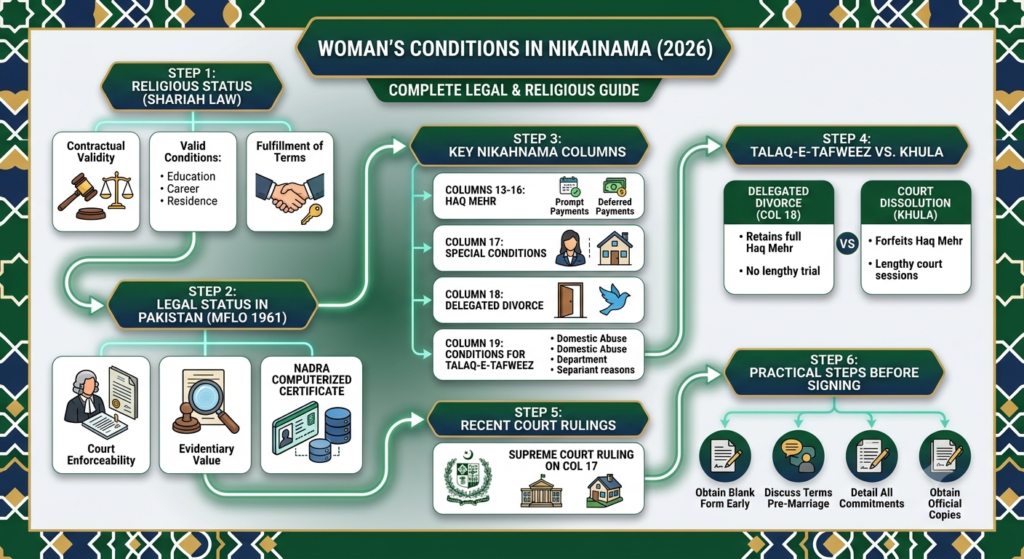
In both Islamic law and Pakistani civil rights, marriage (Nikah) functions as a binding civil contract (Aqd). Consequently, the law empowers both the bride and the groom to negotiate terms before signing the agreement. Furthermore, they can set custom stipulations to establish long-term legal protections.
Despite these clear legal guarantees, cultural social norms often prevent women in Pakistan from exercising their rights. In many cases, wedding registrars (Nikah Khwans) draw lines through crucial columns without asking the couple for permission. Specifically, they strike out sections about special conditions and delegated divorce rights.
This detailed guide explains the religious foundations, statutory rules under Pakistani law, key Nikahnama columns, recent legal rulings, and practical steps every couple must know.
1. Religious Status: What Does Shariah Law Say?
Under Islamic jurisprudence, a marriage contract becomes legally binding upon mutual offer (Ijab) and acceptance (Qubool). Furthermore, Islamic law explicitly allows couples to include mutually agreed-upon terms inside the document. However, these terms must not violate core Islamic principles.
What Makes a Condition Religiously Valid?
Prominent Islamic scholars confirm that husbands must honor every agreed-upon condition in the contract. Generally, a valid condition protects the wife’s personal dignity, financial security, educational goals, or living arrangements. Meanwhile, the condition cannot demand something forbidden (haram) or ban something permitted (halal).
Valid Marriage Conditions in Islam
- Education and Employment: Stipulating that the wife maintains her right to complete higher education or work in her chosen profession.
- Separate Residence: Requiring the husband to provide a private home or living space separate from extended in-laws.
- Fixed Maintenance (Nafqah): Setting a specific monthly financial allowance for the wife’s personal expenditures.
- Restrictions on Second Marriage: Requiring the husband to obtain written consent or pay financial compensation before taking a second wife.
2. Legal Status in Pakistan: The Statutory Framework
In Pakistan, the Muslim Family Laws Ordinance (MFLO) of 1961 governs all Muslim marriages. Therefore, terms written in a registered Nikahnama carry full legal force under civil contract law.
- Court Enforceability: Once the Union Council registers the Nikahnama, courts treat every written condition as a legally binding obligation. If a husband breaks a promise, the wife can file a lawsuit in Family Court for legal remedies.
- Evidentiary Value: Pakistani courts treat the official Nikahnama as a primary public document. As a result, written entries carry strong legal weight during judicial disputes regarding maintenance, property, or divorce.
3. Key Nikahnama Columns Every Couple Must Know
The standard Pakistani Nikahnama contains 25 distinct columns. While Columns 1 through 11 record basic identity details, Columns 12 through 21 establish financial terms and special rights.
Columns 13 to 16: Haq Mehr (Dower Details)
These sections define the dower amount that the husband grants to his wife:
- Prompt Dower (Mu’ajjal): The portion payable immediately at the time of the marriage ceremony.
- Deferred Dower (Muwajjal): The portion payable at a future date, upon demand, or upon termination of the contract.
- Note: You should clearly write down specific cash amounts, gold weight, or property details in these columns.
Column 17: Special Conditions (Sharaait)
This column allows the couple to write tailored legal agreements. For example, you can record clauses regarding career rights, monthly financial allowances, or independent housing here.
Column 18: Delegated Right to Divorce (Talaq-e-Tafweez)
Column 18 asks whether the husband delegates his legal right of divorce to the wife. If you write “YES” in Column 18, the wife gains the authority to dissolve the marriage herself without court litigation.
Column 19: Conditions for Talaq-e-Tafweez
This section details specific triggers for delegated divorce. For instance, non-payment of maintenance, domestic abuse, or taking a second wife can activate this right.
Columns 20 & 21: Polygamy Restrictions
These fields verify whether the groom has existing wives. Additionally, they confirm if he obtained mandatory written permission from the Arbitration Council under MFLO 1961.
4. Understanding Column 18: Talaq-e-Tafweez vs. Khula
Many couples confuse Column 18 (Talaq-e-Tafweez) with court-ordered dissolution (Khula). However, these two legal mechanisms differ significantly in practice.
| Aspect | Delegated Divorce (Talaq-e-Tafweez – Col 18) | Court Dissolution (Khula) |
| Legal Basis | Granted by the husband in Column 18 under MFLO 1961. | Filed directly by the wife through the Family Court. |
| Process | Executed via notice to the Union Council without court trials. | Requires a formal lawsuit, trial evidence, and court sessions. |
| Haq Mehr Status | The wife retains her full dower (Haq Mehr). | The wife typically must surrender or return her dower. |
| Timeframe | Processed within the standard 90-day Union Council window. | Takes several months depending on court case schedules. |
5. Recent Legal Rulings and Statutory Developments
Pakistani courts and state authorities have issued strong directives to enforce Nikahnama conditions and prevent unauthorized document alterations.
Landmark Supreme Court Ruling on Column 17
In a historic decision, the Supreme Court of Pakistan ruled on property listed under Column 17. The apex court declared that assets written in Column 17 form an independent contractual promise separate from standard dower (Haq Mehr). Furthermore, judges ruled that courts must resolve document ambiguities in favor of the wife unless the husband proves lack of consent.
Directives Against Arbitrary Crossing-Out
High Courts and provincial human rights commissions have issued strict notices to Nikah Registrars. Unilaterally striking through Column 17 or Column 18 without explicit permission constitutes an administrative crime. Consequently, registrars who violate this rule risk losing their license.
Digital Verification with NADRA
After the wedding ceremony, the local Union Council logs all Nikahnama entries into the central database. Following registration, NADRA issues an official Computerized Marriage Certificate. This digital system locks all custom conditions into the database and prevents document tampering.
6. Practical Steps for Couples Before Signing
- Obtain an Unfilled Form Early: Secure a blank 25-column Nikahnama weeks before the wedding so both families can review it calmly.
- Discuss Terms Openly: Agree on financial support, career goals, housing arrangements, and Column 18 rights well before the wedding day.
- Instruct the Registrar Directly: Tell the Nikah Khwan in advance that he must not cross out any columns without your explicit consent.
- Detail All Financial Commitments: Write down clear values, dates, and property details for both Prompt and Deferred Haq Mehr.
- Verify and Store Official Copies: Read every column before signing. Afterwards, ensure the Union Council provides both parties with stamped original copies.