
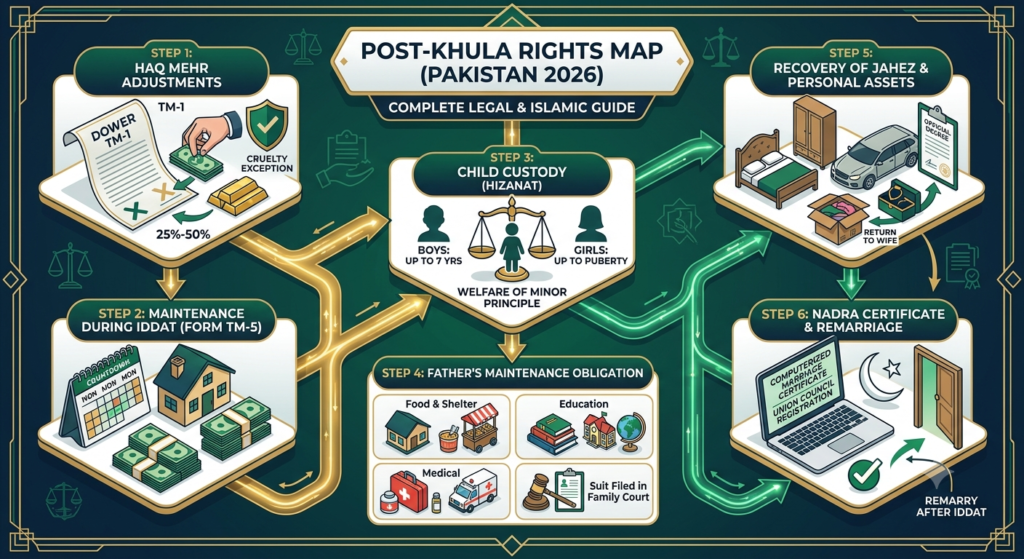
In Pakistan, when a Muslim woman seeks to dissolve her marriage through judicial proceedings without her husband’s consent, she files for Khula. While the process of ending a marriage can be complex, Pakistani family laws and Islamic jurisprudence clearly outline a woman’s legal and financial rights post-dissolution.
Unfortunately, misconceptions surrounding Khula often lead women to believe they lose all financial and parental rights upon leaving a marriage. This detailed guide breaks down a woman’s rights after Khula under both Shariah law and the Dissolution of Muslim Marriages Act, 1939 alongside the Family Courts Act, 1964.
1. Right to Dower (Haq Mehr) Rules
The primary financial consequence of Khula involves the dower (Haq Mehr). Because Khula is a court-decreed dissolution initiated by the wife, specific rules govern what happens to her financial settlement.
Living abroad? We file khula for you without you travelling to Pakistan. See khula for overseas Pakistanis.
Unpaid Dower Forfeiture
Under established Pakistani judicial practice, a woman who seeks Khula must generally forgo her unreceived dower. Consequently, if the husband has not yet paid the deferred dower (Muwajjal), the court usually waives his obligation to pay it.
Return of Received Dower
If the wife has already received her prompt dower (Mu’ajjal), the Family Court may direct her to return a portion of it. However, Pakistani courts carefully distinguish between cash, land, and gold. Typically, judges require the return of 25% to 50% of the received monetary dower, rather than demanding a complete 100% refund.
Exception for Cruelty or Abandonment
Furthermore, if the wife proves severe domestic cruelty, desertion, or failure to maintain under Section 2 of the Dissolution of Muslim Marriages Act, she does not have to relinquish her dower. In such cases, the court grants a judicial divorce rather than a standard Khula, preserving her full financial rights.
2. Right to Maintenance During Iddat
Following the issuance of a Khula decree by the Family Court, the woman must observe the mandatory waiting period (Iddat).
- Iddat Duration: The waiting period lasts for three menstrual cycles (or three months). If the woman is pregnant at the time of Khula, the Iddat period extends until delivery.
- Financial Maintenance (Nafqah): Under Pakistani family law, the ex-husband remains legally obligated to provide basic maintenance, food, and shelter throughout the Iddat period.
- Accommodation Rights: The woman has the right to reside in the marital home or receive adequate housing allowances during these three months.
3. Right to Child Custody (Hizanat)
One of the most persistent myths in Pakistan is that a woman automatically loses custody of her children if she takes Khula. This belief is legally incorrect.
===================================================================================
                  CHILD CUSTODY & MAINTENANCE RIGHTS AFTER KHULA
===================================================================================

       [WIFE FILES FOR KHULA] ──► [FAMILY COURT EVALUATES CASE]
                                          │
                   ┌──────────────────────┴──────────────────────┐
                   ▼                                             ▼
       [CUSTODY RIGHT (HIZANAT)]                     [MAINTENANCE OBLIGATION]
   • Granted based on child's welfare          • Father remains 100% responsible
   • Standard ages:                            • Covers food, shelter, education
     - Boys: Up to 7 years old                 • Father's obligation NEVER ends
     - Girls: Up to puberty                      regardless of Khula decree

===================================================================================
The Welfare of the Minor Principle
Under the Guardians and Wards Act, 1890, Pakistani courts prioritize one central factor above all else: the welfare of the minor. Khula does not penalize a mother or disqualify her from seeking custody.
Custody Age Thresholds
Under Islamic jurisprudence applied in Pakistan, the mother retains the primary right of custody (Hizanat) during early childhood:
- For Sons: The mother generally retains custody until the boy reaches 7 years of age.
- For Daughters: The mother retains custody until the girl reaches puberty.
Even after these age thresholds, the father must file a formal petition in the Guardian Court to request custody transfer. Courts routinely leave children with the mother if moving them would harm their emotional or physical well-being.
4. Right to Child Maintenance
A crucial distinction exists between child custody (Hizanat) and financial maintenance. While the mother provides physical care, the biological father maintains total financial responsibility for his children.
Scope of Father’s Financial Duty
After Khula, the ex-husband must pay monthly child maintenance. This obligation covers:
- Daily food, clothing, and basic living expenses.
- School fees, books, and educational supplies.
- Medical treatment and healthcare costs.
- Suitable accommodation arrangements.
Legal Enforcement
If the father fails or refuses to pay child maintenance after Khula, the mother can file a maintenance suit in the Family Court. Under Pakistani law, courts enforce these maintenance orders strictly, even executing arrest warrants against non-compliant fathers.
5. Right to Personal Property and Dowry Articles (Jahez)
A woman retains complete, unchallengeable ownership over her personal assets and dowry items (Jahez) after Khula.
Recovery of Dowry Items
Dowry items provided by the woman’s family belong exclusively to her. Therefore, the ex-husband or his family cannot confiscate or withhold these items. Upon granting Khula, the Family Court issues an explicit decree directing the return of all recovered dowry items, personal clothing, and gifts.
Personal Assets and Gold
Any property, bank accounts, or gold registered in the woman’s name remain her sole personal property. The court treats these items separately from the dower adjustment process.
6. Summary Comparison: Woman’s Rights Post-Khula
| Category | Legal Right / Status After Khula | Governing Framework |
| Unpaid Dower (Haq Mehr) | Generally forfeited, unless cruelty/desertion is proven. | MFLO 1961 / Family Courts Act 1964 |
| Maintenance During Iddat | Mandatory for 3 months (or until delivery if pregnant). | Islamic Jurisprudence & Pakistani Case Law |
| Child Custody (Hizanat) | Retained based on the minor’s welfare (Boys <7, Girls <Puberty). |