
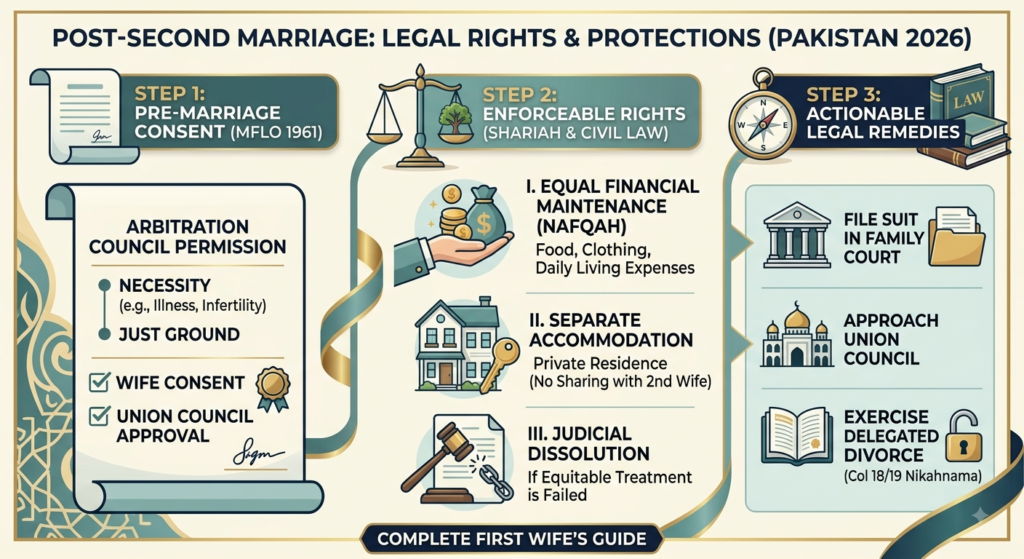
In Pakistan, polygamy is legally regulated and subject to strict conditions under Islamic jurisprudence and statutory law. Many women often wonder about their legal standing, financial rights, and marital protections if their husband decides to take a second wife.
Contrary to common cultural assumptions, a husband cannot simply contract a second marriage at will. The law grants the first wife strong procedural, legal, and financial safeguards. This comprehensive guide details the legal rights of a first wife under Pakistani legislation and Islamic principles.
1. Statutory Permission and Arbitration Council Protection
The primary law regulating second marriages in Pakistan is the Muslim Family Laws Ordinance (MFLO) of 1961. Specifically, Section 6 of the MFLO establishes clear legal barriers to protect the first wife from unannounced or unauthorized second marriages.
Mandatory Consent of the First Wife
Under Section 6 of MFLO 1961, a husband cannot contract a second marriage without obtaining prior written permission from his existing wife (or wives).
Application to the Arbitration Council
Even if the first wife gives her consent, the husband must submit a formal application to the local Arbitration Council. The council consists of the Chairman of the Union Council, a representative chosen by the husband, and a representative chosen by the existing wife.
The Arbitration Council evaluates whether the proposed second marriage is “necessary and just.” Valid grounds generally include:
- Terminal illness or physical incapacity of the first wife.
- Proven medical infertility (supported by medical documentation).
- Unsoundness of mind.
Key Takeaway: If the Arbitration Council or the first wife refuses permission, the husband cannot legally contract a second marriage.
2. Legal Consequences of Contracting a Second Marriage Without Permission
If a husband bypasses Section 6 of the MFLO 1961 and marries a second time without obtaining official permission, the first wife possesses strong legal remedies.
           ===================================================================================
                        LEGAL REMEDIES FOR A SECOND MARRIAGE WITHOUT CONSENT
           ===================================================================================

     [UNAUTHORIZED SECOND MARRIAGE] ──► [VIOLATION OF SECTION 6 MFLO 1961]
                                                    │
                 ┌──────────────────────────────────┴──────────────────────────────────┐
                 ▼                                                                     ▼
      [CRIMINAL PENALTIES]                                                   [IMMEDIATE DOWER DEMAND]
  • Imprisonment up to 1 year                                             • Immediate payment of ENTIRE
  • Fine up to PKR 500,000                                                  Haq Mehr (Prompt & Deferred)
  • Non-bailable legal offense                                            • Enforceable in Family Court
Criminal Prosecution and Fines
An unauthorized second marriage constitutes a criminal offense under Pakistani law. The first wife can file a private complaint before the Judicial Magistrate. Upon conviction, the husband faces:
- Imprisonment for up to one year.
- A substantial monetary fine (up to PKR 500,000, depending on provincial amendments).
Immediate Payment of Entire Haq Mehr (Dower)
If a husband contracts an unauthorized second marriage, his total dower obligation (Haq Mehr)—including both Prompt (Mu’ajjal) and Deferred (Muwajjal) dower—becomes payable immediately.
Even if the couple previously agreed that the deferred dower would be paid upon divorce or death, the unauthorized second marriage automatically accelerates the payment timeline. The first wife can file a suit in Family Court to recover her full dower at once.
3. Right to Equal Treatment and Equal Maintenance (Nafqah)
Islamic law and Pakistani statutory frameworks place a strict mandate of equal treatment on any man who practices polygamy.
Equal Financial Support
Under Islamic law (Shariah), a husband who takes a second wife must treat both wives with strict financial and emotional equality. The first wife’s financial support (Nafqah) cannot be reduced or diverted to fund the second household.
The husband must provide the first wife with:
- Adequate food, clothing, and daily living expenses proportional to his financial standing.
- Payment of educational, medical, and personal needs.
- Uninterrupted payment of any agreed-upon monthly allowance stated in Column 17 of the Nikahnama.
Right to Separate Accommodation
A first wife has the absolute legal right to demand a separate, private living accommodation. She is not legally or religiously obligated to share a residence or kitchen with the second wife. If the husband fails to provide separate living quarters, the first wife can seek court intervention for housing allowances.
4. Right to Dissolution of Marriage (Grounds for Divorce)
If a husband contracts a second marriage in violation of the law or fails to treat his wives equally, the first wife has legal grounds to end the marriage while preserving her financial rights.
Judicial Dissolution Under Act of 1939
Under Section 2(viii)(f) of the Dissolution of Muslim Marriages Act, 1939, a woman can file for judicial divorce if her husband takes an additional wife in contravention of the MFLO 1961, or if he fails to treat her equitably in accordance with Islamic injunctions.
Exercising Delegated Divorce (Column 18)
If the couple recorded a “YES” in Column 18 (Talaq-e-Tafweez) of the Nikahnama, or if they specified second marriage as a trigger in Column 19, the first wife can execute her delegated right to divorce immediately through the local Union Council without forfeiting her dower.
5. Summary Matrix: First Wife’s Legal Rights
| Legal Right / Category | Scope of Protection | Governing Pakistani Law |
| Prior Written Consent | Mandatory written permission required before contracting a second marriage. | Section 6, MFLO 1961 |
| Arbitration Council Review | Marriage must be proven “necessary and just” before an official board. | Section 6, MFLO 1961 |
| Immediate Dower Acceleration | Entire deferred dower (Muwajjal) becomes payable immediately. | Section 6(5)(a), MFLO 1961 |
| Criminal Penalties for Husband | Up to 1 year imprisonment and heavy fines for unauthorized marriage. | Section 6(5)(b), MFLO 1961 |
| Separate Accommodation | Right to independent housing away from the second wife. | Family Courts Act 1964 / Shariah Law |
| Judicial Dissolution | Right to seek court divorce if unequal treatment occurs. | Section 2, Dissolution of Muslim Marriages Act 1939 |
6. Actionable Steps for the First Wife
- Review Your Nikahnama: Check Column 17 (Special Conditions) and Column 18 (Delegated Divorce) to determine what pre-agreed protections exist regarding polygamy.
- Do Not Sign Unclear Documents: If asked to sign consent forms, review the text carefully with an independent legal advisor before providing written consent.
- Approach the Union Council: If you discover an unauthorized second marriage, report the matter to the Chairman of the local Union Council or file a complaint before the Judicial Magistrate.
- File for Maintenance and Dower Recovery: Submit a petition in the Family Court to claim your immediate deferred dower and secure monthly maintenance for yourself and your children.