
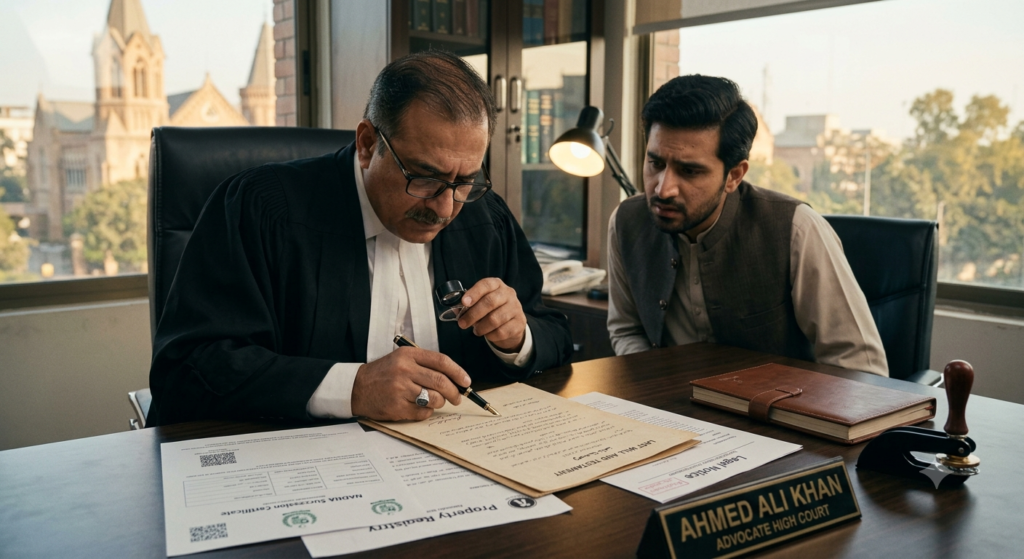
Disputes over inheritance tear families apart. Often, a suspicious or fabricated testament suddenly surfaces after a property owner’s death. In Pakistan, fraudulent relatives or land grabbers routinely manufacture fake wills (Wasiyat). They use these forged papers to rob legal heirs of their rightful Sharia shares.
Islamic law strictly restricts a person’s gifting power to protect natural heirs. A valid will can only distribute a maximum of one-third (1/3) of an estate to non-heirs. Therefore, a completely fabricated will violates both religious and state laws. If you suspect fraud, you must act decisively. This guide breaks down how to challenge a fake will, the evidence you need, and the court procedures involved.
1. Recognize the Red Flags of a Suspicious Will
Before filing a formal lawsuit, you and your lawyer must scrutinize the document. Look for these common indicators of forgery:
- The “One-Third” Rule Violation: Under Islamic jurisprudence, a person cannot give away more than 1/3 of their total estate through a will. This act requires the explicit consent of all legal heirs after the owner’s death.
- Sudden Exclusions: The document completely excludes immediate family members, like daughters or a spouse, without any logical justification.
- Suspicious Timing: The document date closely precedes the testator’s death. This timing raises red flags if they suffered from a severe cognitive illness, dementia, or a comatose state.
- Questionable Signatures: The signature or thumbprint of the deceased looks visibly altered or shaky. It may look drastically different from their official CNIC or bank records.
- Unreliable Witnesses: The marginal witnesses on the will are unknown strangers. Often, they are close associates of the sole beneficiary who stands to gain the entire property.
2. Essential Evidence Needed to Prove Forgery
In a court of law, the person who produces the will must show it is genuine. However, to completely dismantle their claim, you must gather strong documentary evidence:
A. Forensic Handwriting and Biometric Verification
Your lawyer can file an application to send the disputed will to a provincial forensic laboratory.
- Experts will compare the signature on the will against the deceased person’s official signatures on past bank accounts, registered sale deeds, or passport files.
- If the will relies on a thumb impression, forensics will cross-verify it against the NADRA database to check for a biometric mismatch.
B. Certified Medical Records
Did the deceased sign the fake will while elderly or hospitalized? If so, obtain certified copies of their medical history. Hospital charts might prove the testator suffered from advanced dementia, heavy sedation, or unconsciousness on the execution date. In that case, the court will strike down the will due to a lack of a sound mind.
C. Witness Cross-Examination
The law requires at least two competent male witnesses to attest to a property document. Your lawyer will cross-examine these marginal witnesses in court. Contradictory statements regarding the time, place, or signing process will quickly expose the conspiracy.
3. Step-by-Step Court Procedure to Challenge the Will
Step A: File a Suit for Declaration and Cancellation
Your primary civil remedy is filing a formal lawsuit in the local Civil Court. You will file this under Section 39 and 42 of the Specific Relief Act 1877. In this suit, you ask the judge to declare the document fraudulent and nullified.
Step B: Apply for a Temporary Injunction (Stay Order)
File a stay order application alongside your main lawsuit. This requests an immediate temporary injunction under Order 39, Rules 1 & 2 of the Civil Procedure Code (CPC). This step prevents the fraudster from selling, renting, or transferring the disputed property during litigation.
Step C: Register an Objection with the Housing Authority
Hand-deliver a certified copy of your filed lawsuit and stay order to the local land revenue office or housing society. This action formally stops any ongoing mutation (Inteqal) or property transfer process based on that fake document.
4. Criminal Liabilities for Manufacturing a Fake Will
Forging a legal document is a serious criminal offense under the Pakistan Penal Code (PPC). Once a civil court declares the will fake, you can initiate criminal proceedings against the culprits:
- Section 467 PPC (Forgery of a Will): This specific clause deals with the forgery of a will. It carries a severe penalty, including imprisonment for life, or up to 10 years, alongside heavy financial fines.
- Section 471 PPC (Using a Forged Document): Anyone who knowingly presents a fake will in court or before a housing society faces the exact same punishment as the forger.
Pro Tip: If the fraudster applies for a fast-track NADRA Succession Certificate, submit a formal written dispute to NADRA immediately. Once you mark an asset as “contested,” NADRA will freeze the process and direct both parties to a Civil Court.