
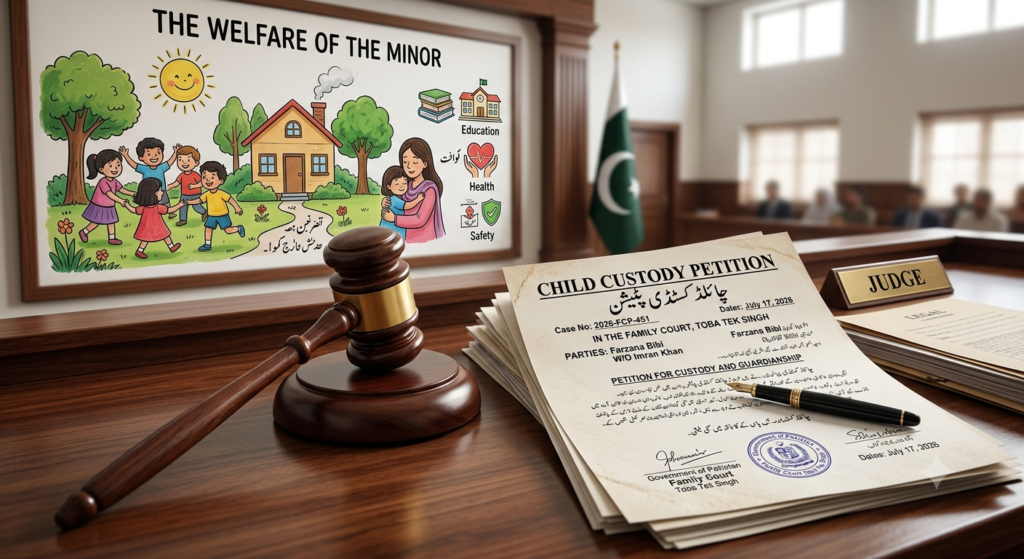
The protection, upbringing, and legal rights of a minor child stand as core responsibilities for any society. When life changes unexpectedly due to divorce, parental separation, or the death of a parent, a child requires absolute legal clarity. In Pakistan, the Guardians and Wards Act, 1890 serves as the primary federal framework for these sensitive matters. This law ensures that a capable, responsible adult can step in to manage a child’s health, lifestyle, schooling, and assets.
To protect your family’s future, you must understand how the family court evaluates applicants. This comprehensive guide details the process of obtaining a Guardianship Certificate. It covers key definitions, required documentation, and every stage of the family court procedure.
1. Understanding Custody (Hizanat) vs. Guardianship (Wilayah)
Many people confuse child custody with legal guardianship, but Pakistani family law treats them as two separate concepts.
- Custody (Hizanat): This term refers to the physical care, day-to-day upbringing, and immediate shelter of the minor child. Traditionally, under Islamic law, a mother holds the initial right of physical custody for young children during their tender years.
- Guardianship (Wilayah): This term represents the overarching legal authority over the child’s person and assets. The legal guardian makes all the vital choices regarding international travel, passport issuance, major medical care, and property management.
The father is the natural legal guardian of his children under eighteen years of age. However, if the parents separate, or if a parent passes away, a person must file a petition in the family court to secure formal legal guardianship status.
2. Types of Court-Appointed Guardians
When you file a petition, you must specify the exact type of authority you are requesting. The Guardian Court generally issues appointments across two primary categories:
A. Guardian of the Person
This appointment grants full legal control over the physical life and day-to-day welfare of the minor child. It allows you to legally handle school enrollments, update educational records, approve medical treatments, and manage standard administrative affairs.
B. Guardian of the Property
If a minor child inherits land, real estate, cash stocks, or bank balances, they cannot legally manage these assets due to their age. The court appoints a Guardian of Property to oversee, protect, and handle these specific financial interests until the minor reaches adulthood.
3. The Ultimate Priority: The Welfare of the Child
You must understand that the Guardian Court does not base its decision solely on blood relationships or financial wealth. Under the Guardians and Wards Act, 1890, the welfare of the minor (Khair-o-Aafiyat) remains the absolute, paramount consideration for the judge.
You must understand that the Guardian Court does not base its decision solely on blood relationships or financial wealth. Under the Guardians and Wards Act, 1890, the welfare of the minor (Khair-o-Aafiyat) remains the absolute, paramount consideration for the judge.
When evaluating your petition, the family court judge closely examines the following details:
- The capacity and character of the petitioner.
- The material and financial stability of the household.
- The religious and cultural compatibility between the child and the applicant.
- The child’s personal preference, if the minor is mature enough to express their wishes (typically aged ten or older).
4. Checklist of Required Documents
To ensure a smooth filing process and avoid immediate procedural objections, you should compile all necessary papers in advance:
- Applicant Identity Proof: A clear copy of your valid CNIC, NICOP, or passport.
- Minor’s Official Records: The NADRA-issued Birth Certificate or Child Registration Certificate (B-Form).
- Family Identity Trees: A NADRA Family Registration Certificate (FRC) to establish the family tree.
- Photographs: Recent color passport-sized photographs of both the applicant and the minor child.
- School and Medical Progress Records: Current school enrollment letters or medical reports to show active care.
- Supporting Certifications: A parent’s death certificate or a formal divorce decree, if applicable to your family’s situation.
- Property Proofs: Registry files, land papers, or bank statements if you are requesting guardianship over inherited property.
5. Step-by-Step Procedure in the Guardian Court
Step 1: Confirm Territorial Jurisdiction
You must file the guardianship petition in the family court of the specific district where the minor child ordinarily resides. For instance, if you live in Rawalpindi but the child lives with relatives in Lahore, you must file the case in the Lahore Family Courts. Filing in the wrong city triggers immediate jurisdictional rejections, wasting precious weeks.
Step 2: Draft and File the Formal Petition
Your family law expert will draft a structured legal petition under the Guardians and Wards Act, 1890. This document explicitly details your exact relationship with the child, the specific reasons for the application, and why your guardianship serves the child’s best interests.
Step 3: Public Notice and Competing Claims
Upon accepting your petition, the court issues formal notices to direct relatives and schedules an initial hearing. Additionally, the judge routinely orders a public notice publication in a daily national newspaper. This step ensures that any person with a competing custody or guardianship claim can present their objections to the court.
Step 4: Local Investigation and Evidence Recording
If the case involves contested issues or property interests, the judge may order an independent local investigation. A designated social welfare officer visits the home to evaluate the safety, hygiene, and emotional atmosphere of your living space. Following the report submission, the court conducts formal hearings to record statements and review your documentary evidence.
Step 5: Submission of Surety Bonds
Before granting the final certificate, the court routinely requires the petitioner to submit Surety Bonds (Zamanat). These bonds act as a legal financial guarantee, ensuring that you will perform your duties honestly and protect the child from harm.
Step 6: Final Judgment and Certificate Issuance
Once the judge is fully satisfied with all safety, character, and welfare conditions, the court passes a final decree. The Guardian Court then officially issues the Guardianship Certificate. This entire process typically concludes within two to six months, depending on whether any family member contests the petition.
6. Crucial Rule for Overseas Pakistanis
If you are an Overseas Pakistani seeking guardianship, you can initiate the process from abroad by executing a Special Power of Attorney (POA). You must have this POA attested by the Pakistani Embassy or Consulate in your resident country before sending it to your lawyer in Pakistan.
Mandatory Rule: The minor child must be physically present in Pakistan and ordinarily reside within the court’s jurisdiction during the proceedings. The family court cannot properly conduct a welfare assessment or interview if the child lives abroad. Therefore, petitions filed for minors already living outside Pakistan face immediate dismissal due to lack of jurisdiction.
7. Duration and Expiration of Guardianship
A standard court-appointed guardianship over a child’s person remains valid until the minor reaches the age of eighteen years, which marks adulthood under the Majority Act, 1875. However, if the court manages complex property inheritances, the legal guardianship over the minor’s estate can extend until the child completes twenty-one years of age. The court can also revoke or modify the certificate early if a significant change in circumstances occurs, or if the guardian fails to uphold their duties.
For more detailed information on the laws related to the child custody, read our this article below