
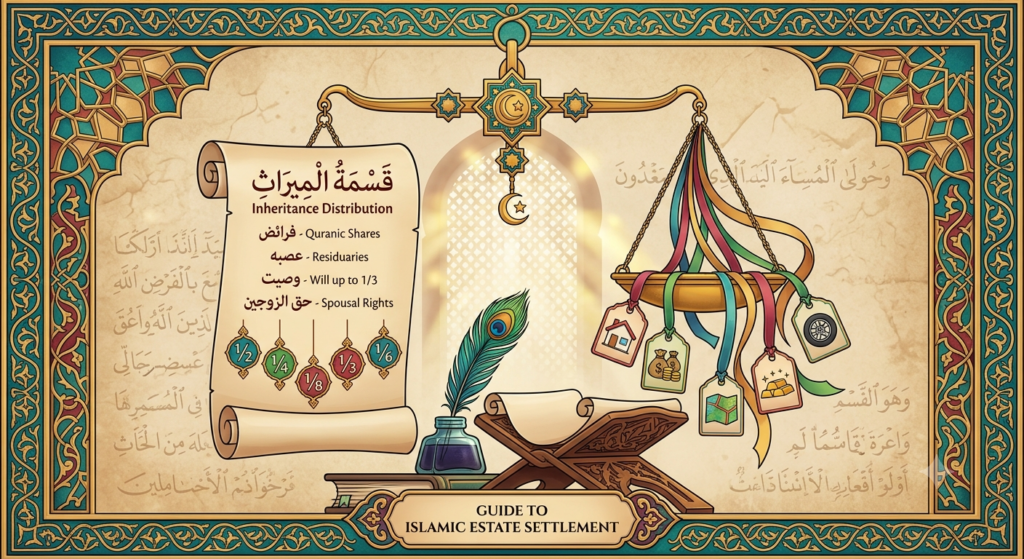
aUnderstanding estate settlement in Pakistan requires navigating both classical Islamic jurisprudence (Fiqh) and statutory civil procedure. Under the West Pakistan Muslim Personal Law (Shariat) Application Act, 1962, the inheritance of a deceased Muslim is governed strictly by their personal religious law (Sunni Hanafi jurisprudence for the majority Sunni population, or Ja’fari jurisprudence for Shia Muslims).
This detailed guide outlines the classical Shariah rules of inheritance, statutory provisions in Pakistan, and the procedural steps for securing title over inherited assets.
1. Mandatory Rights Upon the Estate (Tajheez-o-Takfeen & Liabilities)
Before any asset is partitioned among legal heirs, classical Islamic law and Pakistani courts enforce four sequential rights (Huquq) over the deceased’s total wealth:
- Funeral & Burial Expenses (Tajheez-o-Takfeen): Necessary, moderate costs for washing, shrouding, transporting, and burying the deceased are deducted first.
- Settlement of All Outstanding Debts (Ada-e-Duyun): All debts owed to creditors must be fully discharged. Under Pakistani civil law, unpaid Mahr (dower) owed to a surviving widow is treated as an unsecured debt of the first priority and must be paid out before distributing shares.
- Execution of Bequest (Wasiyat): A valid bequest to non-heirs can only be executed up to a maximum of one-third (1/3rd) of the remaining net estate after debts are cleared. Under Hanafi law, a wasiyat made to an existing primary heir is invalid unless all other adult heirs explicitly consent after the death of the testator.
- Distribution to Legal Heirs (Mirath): The net remaining estate (Tarkah) is partitioned strictly among legal heirs.
Related: How to get a succession certificate in Pakistan (NADRA and court)
2. Classification of Heirs under Sunni Hanafi Law
Sunni jurisprudence structures legal inheritors into three primary legal classes:
A. Sharers (Zawul Furud / Quranic Heirs)
These are relatives who have fixed fractional shares explicitly defined in Surah An-Nisa (Verses 11, 12, and 176). There are 12 Quranic Sharers (4 males and 8 females):
| Relationship | Conditions / Scenario | Fixed Share |
| Husband | If the deceased wife has no children or agnatic grandchildren | 1/2 |
| If the deceased wife leaves surviving children or grandchildren | 1/4 | |
| Wife / Wives | If the deceased husband leaves no children or agnatic grandchildren | 1/4 (Shared equally if multiple wives) |
| If the deceased husband leaves surviving children or grandchildren | 1/8 (Shared equally if multiple wives) | |
| Father | In the presence of surviving children or agnatic grandchildren | 1/6 |
| In the absence of children, he inherits as a Residuary (Asabah) | Remainder | |
| Mother | In the presence of children, agnatic grandchildren, or 2+ siblings | 1/6 |
| In the absence of children or multiple siblings | 1/3 | |
| Daughter(s) | A single daughter inheriting without brothers | 1/2 |
| Two or more daughters inheriting without brothers | 2/3 (Shared equally) |
B. Residuaries (Asabah)
Residuaries take whatever portion of the estate remains after the Quranic Sharers have received their fixed statutory fractions.
- The Rule of 2:1 Ratio: When sons and daughters inherit together, the daughter ceases to be a fixed Quranic Sharer and becomes a Residuary alongside her brother. In accordance with Verse 11 of Surah An-Nisa, a male heir receives twice the share of a female heir ($2:1$ ratio) from the remaining residue.
- Primary Male Line (Agnates): If no direct Quranic sharers exhaust the estate, male agnatic relatives (sons, father, paternal brothers, nephews, paternal uncles) inherit as residuaries in order of proximity.
C. Distant Kindred (Zawul Arham)
Distant relatives connected through female links (e.g., maternal uncles, aunts, or daughter’s children) only inherit if there are no Quranic Sharers (other than a spouse) and no Residuaries.
3. Statutory Provisions in Pakistan: Section 4 of MFLO, 1961
One of the most litigated aspects of inheritance law in Pakistan involves orphaned grandchildren whose parent predeceased the grandparent.
Classical Shariah vs. Statutory Law
- Classical Shariah Rule: Under Hanafi law, a surviving son completely excludes the children of a deceased son (orphaned grandchildren) from inheriting, based on proximity.
- Section 4 of the Muslim Family Laws Ordinance (MFLO), 1961: Introduced statutory per-stirpes succession. It states that if a son or daughter dies during the lifetime of the property owner, that deceased child’s offspring (grandchildren) inherit the exact share their parent would have received had they been alive.
Legal Status in Pakistani Courts
Though the Federal Shariat Court (FSC) declared Section 4 contrary to Islamic injunctions in the benchmark Allah Rakha v. Federation of Pakistan case, an appeal remains pending before the Shariat Appellate Bench of the Supreme Court of Pakistan. By constitutional mandate (Article 203-D), Section 4 of MFLO remains valid and enforced by civil courts and NADRA until the Supreme Court issues a final ruling.
4. Operational Process to Obtain Inherited Assets in Pakistan
Informal division of inherited assets holds no legal standing in Pakistan. Heirs must follow statutory procedures under the Letters of Administration and Succession Certificates Act, 2020 and the Succession Act, 1925.
Step 1: Secure Death Certificate and FRC
- Obtain an official computerized death certificate from the local Union Council or Municipal Corporation.
- Apply for a Family Registration Certificate (FRC) through NADRA, which establishes the tree of legal heirs.
Step 2: Apply for a Succession Certificate
To claim bank deposits, national savings investments, shares, or moveable assets:
- NADRA Succession Counters: Under the 2020 Act, if all legal heirs are adults, present in Pakistan, and agree on the shares, NADRA processes and issues a biometric Letters of Administration / Succession Certificate within 15 days without requiring court intervention.
- Civil Court Petitions: If an heir is a minor, mentally incapacitated, residing abroad without biometric verification, or if the shares are disputed, a formal civil lawsuit must be filed in the local Senior Civil Judge Court under the Succession Act, 1925.
Step 3: Transfer Real Estate Property (Inteqal)
For land, houses, and commercial buildings:
- File an application for Mutation of Names (Inteqal) with the local Land Revenue Authority (Patwari/Tehsildar) or suburban development authorities (CDA, LDA, KDA, DHA).
- Present the official NADRA Succession Certificate or a civil court decree along with field verification signatures from local witnesses.
5. Protection of Female Heirs Under Pakistani Penal Law
Depriving female relatives of their inherited share through coercion, fraud, or forced relinquishment (Tark) is a grave criminal offense in Pakistan.
Under Section 498A of the Pakistan Penal Code (PPC), using deceit, coercion, or intimidation to prevent a female heir from inheriting property is punishable by:
- Imprisonment for a term extending up to 10 years (with a mandatory minimum of 5 years).
- A fine of PKR 1,000,000 or more.
Pingback: Succession Certificate in Pakistan: NADRA & Court Guide