
Modern businesses execute contracts, agreements, and approvals online every day. As digital transformation accelerates across Pakistan, understanding the legal standing of electronic signatures (e-signatures) becomes vital for everyone. Many business owners ask whether an online click or digital signature carries real weight in court.
Fortunately, Pakistani law explicitly recognizes electronic signatures. Therefore, digital signatures hold full legal validity when you follow national regulations. This detailed guide explains the legal framework, practical signature types, court rules, and key exceptions under Pakistani law.
1. Primary Laws Governing Electronic Signatures in Pakistan
Pakistan introduced cyber laws early to facilitate digital trade across the country. As a result, specific statutes provide a strong foundation for legalizing digital records and online signatures.
The Electronic Transactions Ordinance (ETO), 2002
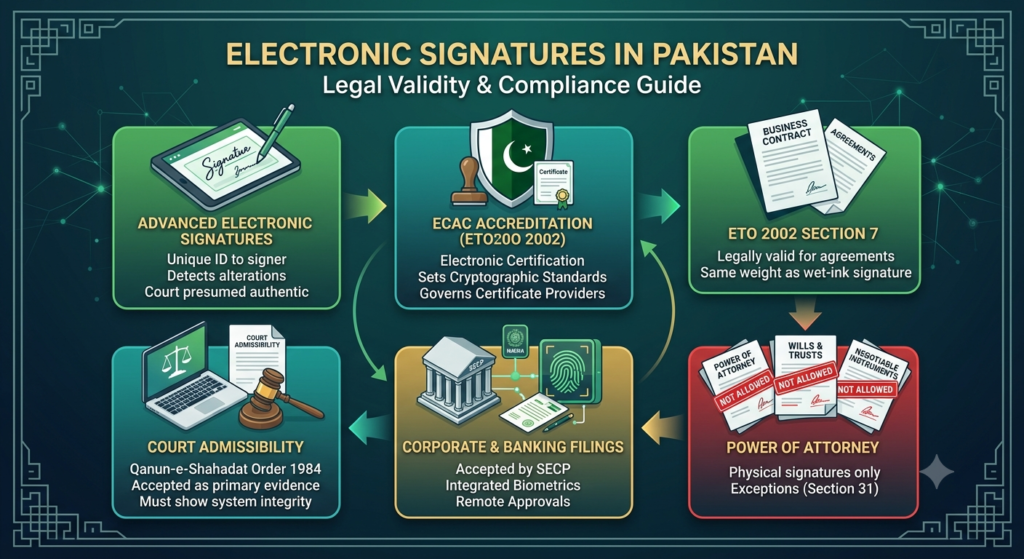
The Electronic Transactions Ordinance (ETO), 2002 serves as the primary federal law regulating digital transactions in Pakistan. Section 3 of the Ordinance states that courts cannot reject a document simply because it exists in electronic form. Furthermore, Section 7 explicitly establishes that an electronic signature satisfies any legal requirement for a physical signature.
Amendments to the Qanun-e-Shahadat Order, 1984
The government also amended the Qanun-e-Shahadat Order, 1984 (Pakistan’s Law of Evidence) to support digital growth. Because of these updates, courts accept electronic records as primary evidence. However, you must still prove the security and integrity of your digital signing system.
The Electronic Certification Accreditation Council (ECAC)
The federal government created the Electronic Certification Accreditation Council (ECAC) under Section 18 of the ETO 2002. Today, the ECAC acts as the main regulatory body for digital security. Consequently, it oversees technical protocols, issues digital certificates, and ensures that e-signature platforms meet national security standards.
2. Categories of Electronic Signatures Under Pakistani Law
Pakistani law divides electronic signatures into two main categories based on their security levels.
Standard Electronic Signatures
Under Section 2(n) of the ETO 2002, a standard electronic signature includes any symbol, code, or image attached to a digital document. For instance, typing your name at the end of an email or attaching a scanned signature image qualifies as a standard signature. Additionally, checking an “I Agree” box on a website fits this category.
While standard e-signatures are legally valid, Section 8 requires you to prove their authenticity. Therefore, if a dispute arises, you must prove in court that the specific person actually created that signature.
Advanced Electronic Signatures
Section 2(d) defines an Advanced Electronic Signature as a secure digital signature with strict technical safeguards. First, it links uniquely to the signer. Second, it identifies the individual clearly. Third, it remains under the sole control of the signer. Finally, it detects any tampering with the document after signing.
Under Section 9, courts automatically presume that an advanced electronic signature is authentic and genuine. As a result, the court places the burden of proof on anyone who challenges your signed agreement.
3. Practical Applications Across Regulated Sectors
Many government bodies and corporate regulators in Pakistan actively use electronic signatures today.
SECP Corporate Filings
The Securities and Exchange Commission of Pakistan (SECP) leads digital corporate governance. Company directors now submit annual returns and incorporation forms through the SECP eServices portal. Consequently, business owners can execute binding corporate documents remotely without physical paperwork.
Banking and Biometric Integration
Financial institutions use e-signatures alongside biometric verification systems provided by NADRA. Banks integrate NADRA’s digital services to verify customer signatures, open bank accounts, and approve digital loan applications safely.
E-Filing in High Courts
Judicial bodies across Pakistan, including the Lahore High Court and Islamabad High Court, now embrace digital filing. Judges routinely sign court orders electronically. Similarly, lawyers submit digital pleadings and affidavits through secure online portals.
4. Legal Exceptions: Where You Cannot Use Electronic Signatures
Although Pakistani law broadly supports digital contracts, Section 31 of the ETO 2002 creates specific exceptions. Therefore, you must still use traditional pen-and-paper signatures for the following legal documents:
- Negotiable Instruments: Promissory notes, bills of exchange, and cheques under the Negotiable Instruments Act, 1881 require physical signatures.
- Power of Attorney: Documents granting legal power of attorney under the Powers of Attorney Act, 1882 require physical execution and traditional witnessing.
- Wills and Trusts: Testamentary documents, wills, codicils, and trust deeds require traditional paper execution and physical attestation.
- Real Estate Property Sales: Contracts transferring title, property sale deeds, or land mortgages still require physical signatures and local registry endorsement.
5. Summary Checklist for Using E-Signatures Legally
- Check the Document Type: First, verify that your document does not fall into excluded categories like land deeds or power of attorney.
- Choose Advanced Signatures: Next, use ECAC-accredited digital signatures for high-value business contracts to secure legal protection.
- Save Digital Audit Trails: Always save timestamps, IP addresses, and email logs to prove signature integrity in court.
- State Digital Consent Clearly: Finally, state clearly in your contract that all parties agree to conduct business electronically under ETO 2002.
M