
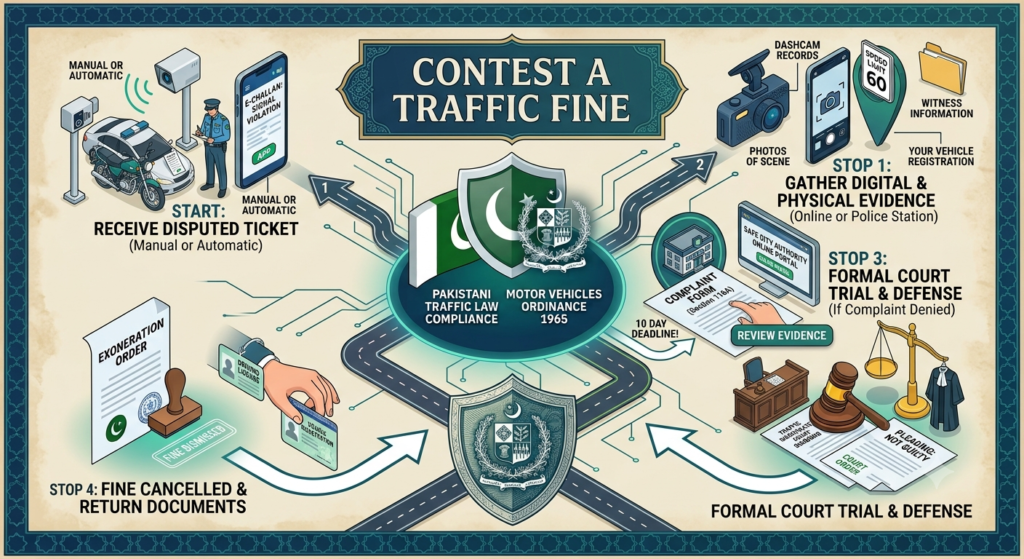
Receiving a traffic ticket (challan) can feel frustrating, especially when you believe the traffic officer or automated camera system issued the fine in error. In Pakistan, thousands of motorists face incorrect traffic penalties daily due to technical glitches in automatic camera systems, misread license plates, or mistaken identity on the road. Many drivers simply pay the fine to avoid hassle, completely unaware that Pakistani law gives every citizen a legal mechanism to challenge an unjustified traffic fine.
Under the Provincial Motor Vehicles Ordinance, 1965, a traffic ticket acts as an allegation of an offense rather than an immediate final judgment. You possess the legal right to contest the fine before a Traffic Magistrate or through administrative complaint channels if you hold evidence that you did not commit the violation. This detailed guide explains your rights, the exact legal procedures for challenging a manual or e-challan, and how to defend yourself effectively.
1. Understanding the Legal Framework for Traffic Tickets
Traffic management and law enforcement fall under provincial jurisdiction in Pakistan. Police officers and automated monitoring authorities draw their legal powers from specific statutes that dictate how they must issue tickets.
The Provincial Motor Vehicles Ordinance, 1965
The Provincial Motor Vehicles Ordinance, 1965 serves as the primary legislation governing road traffic, licensing, and driving violations across all provinces in Pakistan. Section 116-A of this Ordinance lays down the summary procedure for ticketing traffic offenders. Under this provision, an authorized traffic warden or police officer must issue a standardized violation form (Form-J) on the spot when they observe a moving or parking violation.
Manual Tickets vs. E-Challans
Understanding the difference between manual tickets and automatic e-challans helps you choose the correct legal channel for your dispute:
- Manual Tickets: A traffic warden stops your vehicle on the road, inspects your driving license or registration papers, and handwrites a paper ticket detailing the alleged infraction. The officer usually seizes one of your original documents (such as your driving license or vehicle registration book) until you settle or contest the fine.
- E-Challans: Automated smart-city camera networks (such as those operated by the Punjab Safe City Authority or Islamabad Capital Territory Police) capture image evidence of speeding or signal violations. The system generates an electronic ticket and sends it directly to the address of the vehicle’s registered owner. High Courts in Pakistan have frequently observed that e-challans must strictly adhere to statutory authorization and personal liability standards, meaning authorities cannot penalize an innocent vehicle owner for a violation committed by someone else driving their car.
2. Immediate Actions After Receiving a Disputed Ticket
Taking quick, deliberate action immediately after receiving an erroneous fine significantly increases your chances of getting the penalty revoked.
Collect and Secure Critical Evidence
You must gather physical and digital evidence to build a convincing defense before filing an official complaint. Take clear photos or recorded video of the incident location, including visible road signs, traffic signals, speed limit displays, or lane markings that support your position. If an e-challan features a misread license plate or shows a different vehicle model altogether, take photographs of your own vehicle from similar angles to highlight the discrepancy clearly. Always save dashcam footage, GPS logs, digital fuel receipts, or bank transaction records that prove your vehicle’s actual location during the time of the alleged violation.
Avoid Missing Statutory Deadlines
Every traffic ticket carries a strict deadline for resolution. Under standard provincial rules, a driver usually receives ten days to clear or contest a manual ticket at the designated traffic sector office. If you let this deadline pass without taking legal action, the traffic department automatically forwards your seized driving documents to the local Judicial Magistrate. At that stage, retrieving your documents requires paying double the original fine or appearing in court for formal proceedings.
3. Administrative Review Procedures (Traffic Police Complaints)
Before taking your case to court, you can resolve minor clerical errors or obvious mistakes directly through administrative complaint channels set up by the traffic police department.
Filing a Complaint at the Traffic Sector Office
If a traffic warden issues an unfair manual ticket, visit the concerned Traffic Sector Office in your district within the initial 10-day window. Ask to speak directly with the Sector In-Charge or the Senior Superintendent of Police (SSP) Traffic. Submit a concise written application detailing why the ticket is incorrect, attach your supporting evidence, and request an administrative cancellation of the fine. Traffic supervisory officers hold discretionary authority to cancel ticket entries if they detect clear officer error or misidentification.
Resolving E-Challan Errors Online
If you receive an incorrect e-challan in your name due to a camera system glitch or stolen vehicle identity, use the online grievance portals managed by the regional traffic authority or Safe City project. Submit your complaint through the official e-challan web portal, upload clear proof of your vehicle’s registration details, and point out the error in the captured photograph. Safe City technical boards review these submissions regularly and routinely void e-tickets that reveal unreadable number plates or mismatched vehicle models.
4. Contesting the Ticket Before a Judicial Magistrate
If administrative officers decline to cancel your fine and you remain confident in your innocence, you can exercise your statutory right to take the matter to court.
Requesting Trial Before the Traffic Court
When a warden issues a manual ticket, refuse to accept guilt by instructing the officer to send the ticket directly to the designated Traffic Magistrate or Summary Court. The officer will forward the Form-J ticket along with your seized documents to the court registry. The Judicial Magistrate will issue formal court summons giving you a specific hearing date to present your defense.
Presenting Your Defense in Court
On your assigned court date, appear before the Judicial Magistrate with all your original documents, CNIC, and compiled evidence folders. The magistrate will read out the summary traffic charge against you. When you plead “not guilty,” the court evaluates the evidence provided by both the reporting traffic warden and yourself. If your dashcam footage, photographic evidence, or witness testimony creates reasonable doubt regarding the violation, the magistrate will issue a formal exoneration order, dismiss the fine, and order the immediate release of your seized documents.
5. Essential Checklist for Challenging Traffic Fines
- Inspect Details Immediately: Read every detail on the paper ticket or e-challan, checking your vehicle registration number, date, time, and specific violation code.
- Document the Scene: Capture photos or videos of the traffic intersection, road signs, or signal indicators if a warden stops you unfairly.
- Act Within 10 Days: Visit the local Traffic Sector Office or lodge an online complaint before the initial 10-day deadline expires to avoid penalty doubling or automatic court referral.
- Never Ignore Court Summons: If your ticket moves to the Judicial Magistrate, attend the hearing promptly with your evidence to avoid arrest warrants or license suspension.